



The Emergence of a New Resourcing Model
The resourcing model built around fractional executive resources has evolved significantly in the past 10 years, from its early application to the finance function in businesses. Prior to the pandemic, the model was finding excellent traction with mid-market businesses, and especially with fractional leadership roles in marketing, finance, and sales.
Today, the fractional executive staffing model is widely understood and has been applied to every CXO function. It has also found acceptance in larger corporations as well as small businesses. The number of fractional organizations which offer staffing services and qualified execs has grown, too. For example, when I started as a fractional Chief Marketing Officer in 2015 there was one major firm offering fractional CFO resources and one smaller firm offering fractional CMO resources. Today, there are many options for any CXO position.
In my early days as a fractional CMO, I had to first sell the concept before I could sell myself to many clients. I was fortunate to spend time with a networker who refused to look at my resume draft but instead said: “You have clearly been a successful executive, and you are not inexpensive. Your job is to find businesses with problems you can solve.”
Ten years on from that meeting that guidance has proven to be successful. Over fifty (50) clients, 75 blogs, and five eBooks later I recognized that my approach to fractional roles was different. “Different” as in the ability to successfully create client value. Since I am in the “give it away” window of my career, here is my advice and guidance to anyone wanting to be a high-performing fractional exec.
Recognize Your Expertise and Turn that into Client Solutions
Given the problem-solving nature of a fractional exec, how do you create value? You are likely a well-experienced former corporate executive, but that is no guarantee that your career in the fractional space will bring you success.
Learn How to Offer Guidance
First, you may need to operate in a role which may include immediate financial pressure, and where your influence, not your control, is a critical part of your success. I always differentiated myself from industry consultants by sharing upfront my view on how I help businesses I work with be more successful. That means working with the exec team as I would if I was hired as an FTE. That involves respecting them and what they have achieved and includes empathy for the problems that they are facing.
That also includes differentiating between being a consultant and performing advisory work. Many industry consultants still have a reputation for failed client engagements where they over-promise, under-deliver, and charge more than agreed without delivering any real value.
Here is what not to say to new clients: “I am your new interim CXO, and you must listen to me. I have lots of experience at…then list company’s you worked for—the bigger the better.” I had a colleague who did this with a client, and we were only a couple of weeks into the engagement. His tenure abruptly terminated.
I like to avoid words like “part-time and interim,” too. I say: “I’m going to join your team for as long as it takes to get you to the goals you set, and you can tell me you’re ready to fly on your own any time.”
I despise the word “client,” too, although for brevity I will use it in this blog. Later in my career I learned how to eliminate it from my vocabulary. I do not have “clients.” I have businesses I support as they try to grow profitably and produce better results for their owners, board, staff, and staff families.
Look Around the Table When Problems Come Up. If You have a Solution, Offer it!
Some of my colleagues make the mistake of avoiding any tasks which are not clearly part of the engagement process. I think that is wrong. If you worked for a business and something came up which you recognized that you could address better than anyone else, jump in.
I once arrived at a business’ HQ, and the CEO asked me if I could visit with her. Was I getting terminated? Did something bad happen? Nope. The business shipped its queue of orders in December and now had five production people with nothing to do. They would have to be released. The CEO wanted me to write out five cards in my handwriting with high value gift certificates to the five employees involved so they did not know that it came from her alone.
The fractional CMO firm I was working for at the time thought an 18-month long engagement was exceptional. My approach to value created engagements of multiple years, some as long as six- to eight years. It almost always led to an extension of the original work we contracted for. Why? It is about being valued and trusted.
Codify Your Expertise
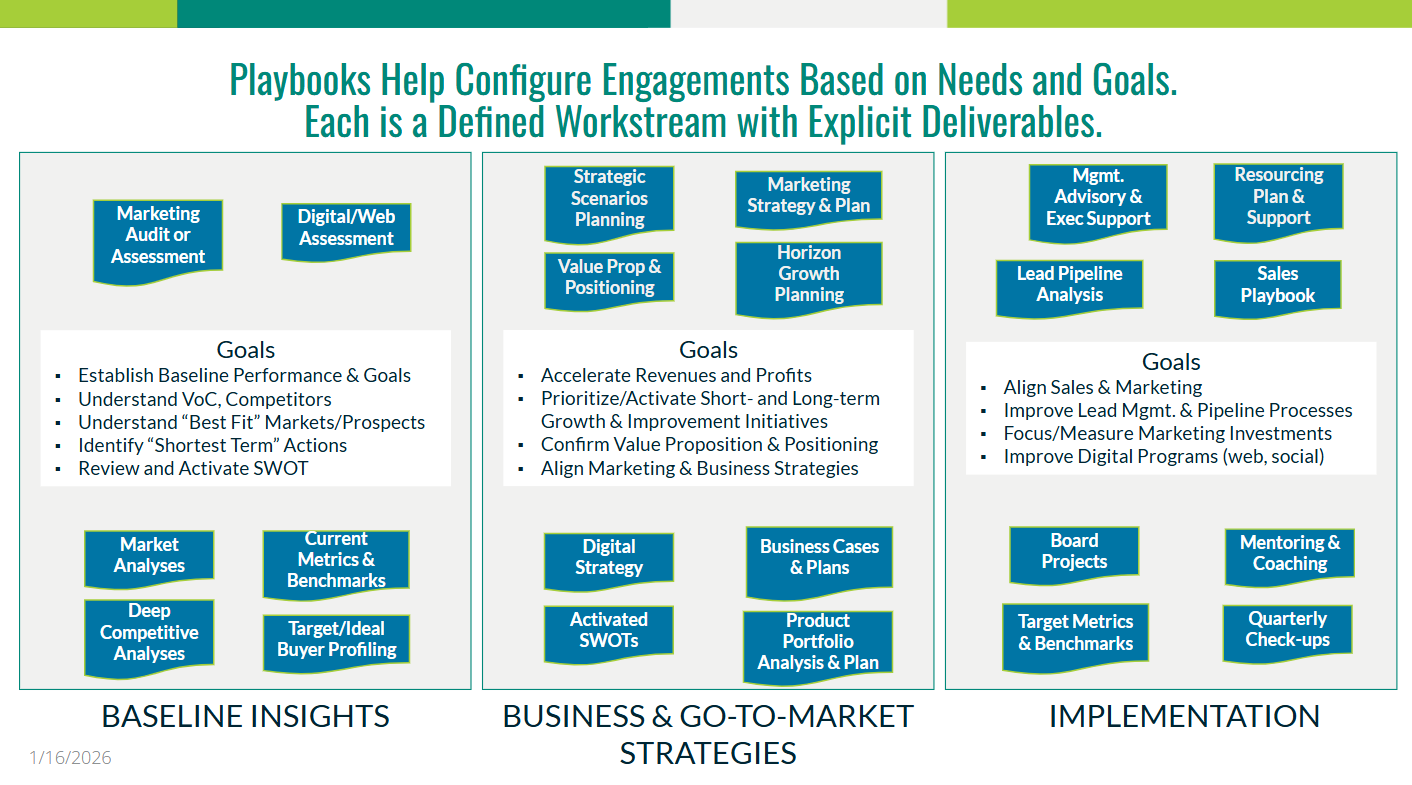
Playbooks make it easier for your clients to understand what you will deliver, when you will deliver it, what roles and support they will have to provide, and what their investment will be. A playbook is a way to demonstrate your knowledge while helping the buyer feel comfortable about what you will deliver. Playbooks make services more real, and that helps eliminate buyer objections. And since playbooks are not offered by many fractional execs, when you develop them, they will make you unique and will improve your ability to close new deals.
Playbooks are powerful, and I learned how easy they make it for a new client to hire you. Playbooks contain:
- engagement roadmaps that organize your work into categories which align with their business needs (think Gantt chart)
- lists of specific tasks under each category along with specific deliverables
- identification of key milestones
As a fractional CMO, I developed 15+ playbooks in three major categories for prospects to consider:
Insight-related Playbooks
- Marketing Audit, Digital/Web Audit, Deep Competitive Analysis, Ideal Customer Profiling
Business and Go-to-Market Strategy-related Playbooks.
- Scenario Planning, Marketing Strategy & Plan, Value Proposition and Positioning, Product Portfolio Analysis, and Business Cases
Performance Improvement-related Playbooks
- Sales Pipeline Analysis, Sales Playbook, Target Metrics, Quarterly Checkups, and Coaching
Once I understood my business prospect’s needs and problems, I would package the relevant Playbooks as an Engagement Roadmap. My success rate of closing new businesses, when I was able to demonstrate my expertise in this manner, was over 90%.
Playbooks also improve your productivity because you know exactly how you will approach each need.
Find Other Ways to Demonstrate Your Expertise
Fractional execs compete with several audiences: fractional execs from other firms, other execs bidding for the same work in your firm, independent consultants, and large consulting firms.
The fractional CMO firm I affiliated with a few years ago encouraged me to write blogs and e-Books and they were published on the corporate website, being fresh new content. Once you have a series of blogs, if you organize them in context, you can compile related topics into e-Books.
Click here if you would like to check out my blogs and e-Books:
https://thepracticalcmo.com/blog-posts/
https://thepracticalcmo.com/e-books/
Once you have blogs and e-Books it may be time to try podcasts. Honestly, I am not much of an audio learner, but there are many of you who are, and I learned to have fun with my podcasts. If you write blogs and e-Books and host podcasts, you are among the elite class of fractional execs.
Click here to check out my podcast series: https://thepracticalcmo.com/podcast/
I had more than a few new business prospects who had reviewed my content before we met in person. One CEO, after we introduced ourselves, turned his monitor around and asked: “Did you write this e-Book?” When I told him I had, he said, “I want this, when can you start?” That was the shortest sales process ever!
Be Realistic About Who You Are
Resumes do not tell you much about a person. I strongly advocate for developing a relevant set of personal attributes for every position I help hire. Understanding the attributes required for someone to be successful in every role is a much better litmus test of future success.
In previous roles, I’ve managed Marketing and Sales departments, and had roles as a COO and a CIO. In these roles, I constantly faced decisions about whether (a) it was better to hire a functional expert and then teach them your product or service; or (b) take someone with business and product knowledge and give them necessary training. The reason approach (a) works best is because it relies on personal attributes.
I have interviewed many fractional CMO prospects who indicated to me that, even though they claim they would be fine with selling themselves, they have no experience. They have never prospected, or developed their professional network, or done cold-calling, or done anything remotely considered business development. More important, they do not have the right attributes for a business developer or salesperson.
Most fractional CXOs are required to develop somewhere around 50% of their own business, especially when they are part of a fractional organization.
Make a list of personal attributes, then honestly score yourself on how comfortable you are with the list.
Evaluate Yourself Here: https://www.explorepsychology.com/list-personality-traits/
Pick A Lane
You cannot cover the globe of business opportunities, even if you are affiliated with a fractional CXO firm. Before becoming a fractional CMO, my corporate background was in business services and financial services.
My first fractional assignment was with a consumer business tucked inside of a metal fabricator. That led to other manufacturing opportunities, and like a good marketeer, when I understood the size and number of manufacturing businesses in the region I wanted to focus on in the Upper Midwest, there were more than 20,000 of them, most of which were small- or mid-sized and a good fit for a fractional CMO
And if you know the manufacturing industry, you will likely agree with me that Marketing is usually not their competency or priority. They often have a problem with profitable business growth and with effective go-to-market programs as they prioritize operational excellence, but do not apply that same thinking to Sales and Marketing. That is a problem area I knew I could help them with. Over time I developed a reputation as a CMO with manufacturing expertise.
What’s Next? Learn, Adapt, and Always Look for Ways to Add Value.
The role of a CXO continues to evolve. Stay current in your field of expertise and even try to develop beyond that field you consider yourself to be an expert in. Understand how new technologies like AI can be transformational. Get in front of the businesses you support and help them navigate a path to success. Be a value-added player every day!
Contact Information:
Mark Coronna, Founder, The Practical CMO®
mark@thepracticalcmo.com
LinkedIn: https://www.linkedin.com/in/markcoronna/
© 2026 Mark S. Coronna


